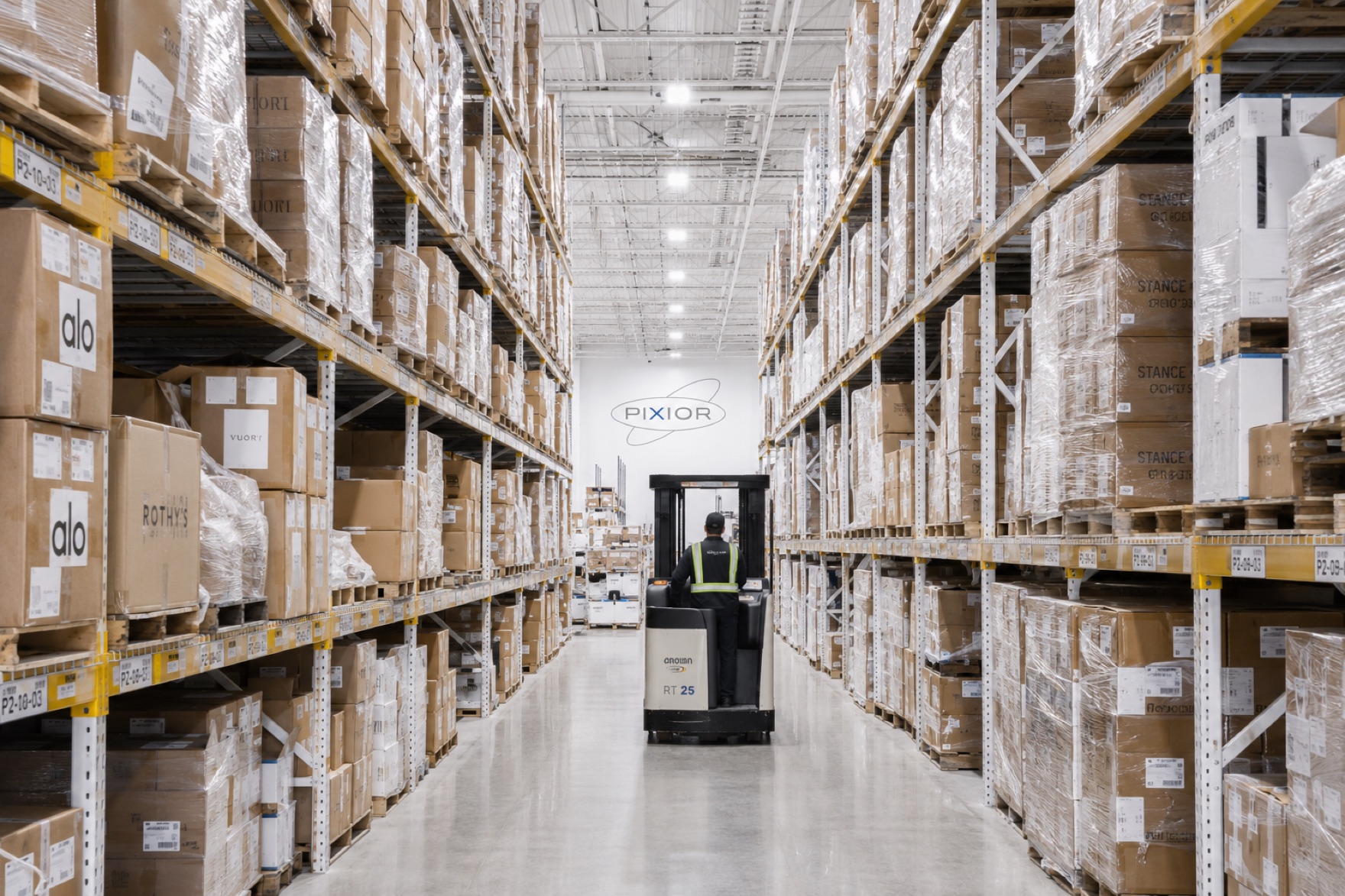
Organized inventory inside a Pixior fulfillment center
Pixior Learning Center

The 3PL Beginner's Guide

A simple, practical explanation of third-party logistics, fulfillment, shipping, inventory, returns, and the terminology brands hear every day.

Start with how it works
Start Here

What is a 3PL?

A third-party logistics provider is the operations partner that stores your inventory and helps move each order from your sales channel to your customer or retail partner.

Your brand keeps control of the product, customer experience, and business decisions. The 3PL manages agreed warehouse, fulfillment, shipping, retail preparation, and returns workflows behind the scenes.

From Arrival to Delivery

How a 3PL works, step by step.

Every operation is different, but most fulfillment programs follow the same basic path.

  1. 01

    Connect the systems

    Your ecommerce platform, marketplace, ERP, EDI provider, or order system sends orders and product information to the 3PL.

  2. 02

    Receive the inventory

    The warehouse receives products, verifies quantities and condition, records discrepancies, and makes approved units available in inventory.

  3. 03

    Store each SKU

    Products are assigned to organized storage locations based on their size, velocity, handling requirements, and sales channels.

  4. 04

    Release the order

    A valid customer, marketplace, wholesale, or retail order enters the warehouse system with its service and routing requirements.

  5. 05

    Pick and pack

    The correct units are scanned, picked, inspected, packed, labeled, and prepared according to your brand and channel rules.

  6. 06

    Ship and report

    The package or shipment is handed to the selected carrier. Tracking and shipment details flow back to your systems and customer.

  7. 07

    Manage returns

    Returned products are received, inspected, graded, repaired or repackaged when possible, and returned to available inventory based on your rules.

One Warehouse, Different Rules

Understanding the major sales channels.

DTC

Direct to Consumer

Individual orders placed on your website and shipped directly to each customer. Packaging, delivery speed, tracking, and presentation are central to the experience.

Explore ecommerce fulfillment →

B2B

Wholesale and Retail

Larger shipments sent to retailers, boutiques, distributors, or other businesses. These orders often require routing guides, EDI, ASNs, appointments, and retailer-specific labeling.

Explore B2B and omnichannel →
MKT

Marketplaces

Orders from Amazon, TikTok Shop, Walmart Marketplace, and other platforms. Each marketplace can have its own inventory, packaging, timing, and compliance requirements.

Explore integrations →
Visibility and Control

What should you be able to see?

A strong 3PL relationship should give you clear operational information without requiring a phone call for every answer.

  • Inventory by product, size, color, and location
  • Order status and shipment tracking
  • Returns, inspections, and disposition
  • Exceptions that need a decision
  • Accuracy, shipping, and service performance
  • Receiving progress and inventory availability
Plain-English Glossary

Common 3PL terms without the jargon.

These are the phrases you are most likely to hear while planning or operating a fulfillment program.

3PL
Third-party logistics. A company that manages outsourced logistics work such as warehousing, fulfillment, shipping, and returns.
ASN
Advance Ship Notice. An electronic message that tells a retailer or warehouse what is arriving before the shipment gets there.
Cycle Count
A scheduled count of selected inventory locations used to verify accuracy without stopping the entire operation for a full physical inventory.
DTC
Direct to consumer. Orders sold by a brand and shipped directly to the individual customer.
EDI
Electronic Data Interchange. A standard way for businesses and retailers to exchange documents such as purchase orders, ASNs, and invoices.
ERP
Enterprise Resource Planning system. Software that can connect finance, purchasing, inventory, orders, and other business processes.
Kitting
Combining multiple products or components into one ready-to-ship set, bundle, subscription box, or promotional package.
Omnichannel
Operating multiple sales channels together, such as ecommerce, marketplaces, wholesale, and retail, using coordinated inventory and workflows.
Pick and Pack
The warehouse process of selecting the correct items for an order, verifying them, and packing them for shipment.
Routing Guide
A retailer's instructions for labeling, packing, scheduling, routing, documentation, and delivery.
SKU
Stock Keeping Unit. A unique identifier for one specific product variation, such as a black shirt in size medium.
SLA
Service Level Agreement. The documented performance expectations for agreed services, timing, accuracy, and responsibilities.
VAS
Value-Added Services. Work beyond basic storage and shipping, such as ticketing, labeling, folding, polybagging, kitting, inspection, and display assembly.
WMS
Warehouse Management System. Software that tracks inventory locations and directs warehouse receiving, picking, packing, and shipping activity.
Chargeback
A fee or deduction issued by a retailer when a shipment does not follow its routing, labeling, timing, or documentation requirements.
Reverse Logistics
The movement and processing of products coming back from customers or retailers, including inspection, repair, repackaging, restocking, or other disposition.
Choosing a 3PL

Questions worth asking before you sign.

The right partner should understand how your business works today and what will change as you grow.

Can the operation support all of our channels?

Explain your current and planned mix of ecommerce, marketplace, wholesale, retail, and cross-border orders. Ask how inventory and channel-specific rules will be managed together.

How will our systems connect?

Confirm which platforms, marketplaces, ERPs, EDI networks, and APIs are supported. Understand what data will move in each direction and who owns testing.

How is inventory accuracy protected?

Ask about barcode scanning, receiving controls, storage by SKU and variant, cycle counts, exception handling, and the inventory reports you will receive.

What happens during peak periods?

Share realistic order history, promotions, launches, and seasonal forecasts. Ask how labor, space, packaging, carrier pickups, and communication are planned for a surge.

Who answers when something changes?

Understand your day-to-day contacts, escalation path, reporting cadence, and how quickly the team communicates when an exception requires a decision.

Still Have Questions?

Bring us your workflow. We will explain the next step clearly.

No jargon, no call center, and no assumption that your business has to fit one standard template.

Call +1 (424) 558-4555
Talk to a Supply Chain Lead

Come see the actual buildings.

Fifteen minutes with a supply chain lead. Bring your worst month's numbers.

HQ: 7400 Slauson Ave, Commerce, CA 90040.

We reply within one business day. No call center.

Fulfillment built for brands that can't afford mistakes.

Response within 24 hours.

Proudly teaming up with amazing partners to deliver trusted,
full-service 3PL solutions since 2000.
Los Angeles, the East Coast, and Europe. Port-to-door under one vendor, one team that answers.